
A few days back
I celebrated my 64th spin around the sun.

As usual–I celebrated, because I like to celebrate.
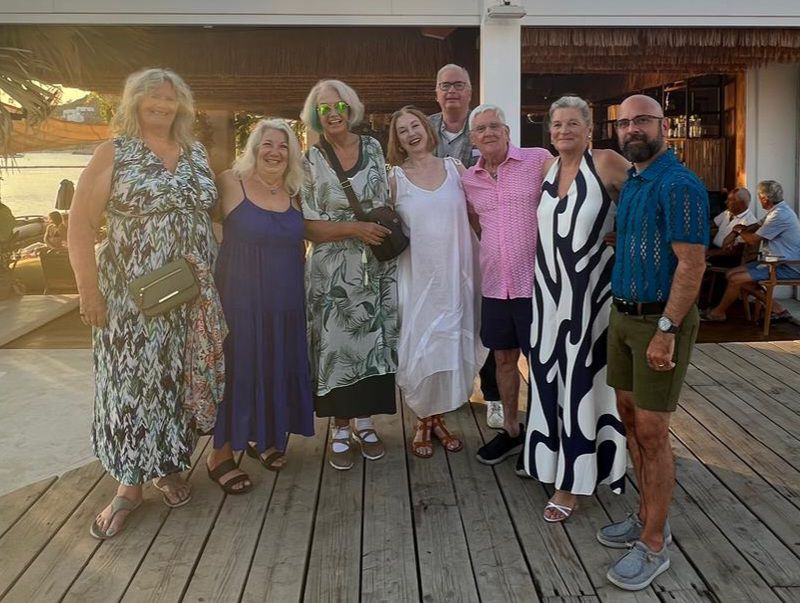
Two dozen dear ones gathered at a sit-down dinner at one of my favorite venues on the island.
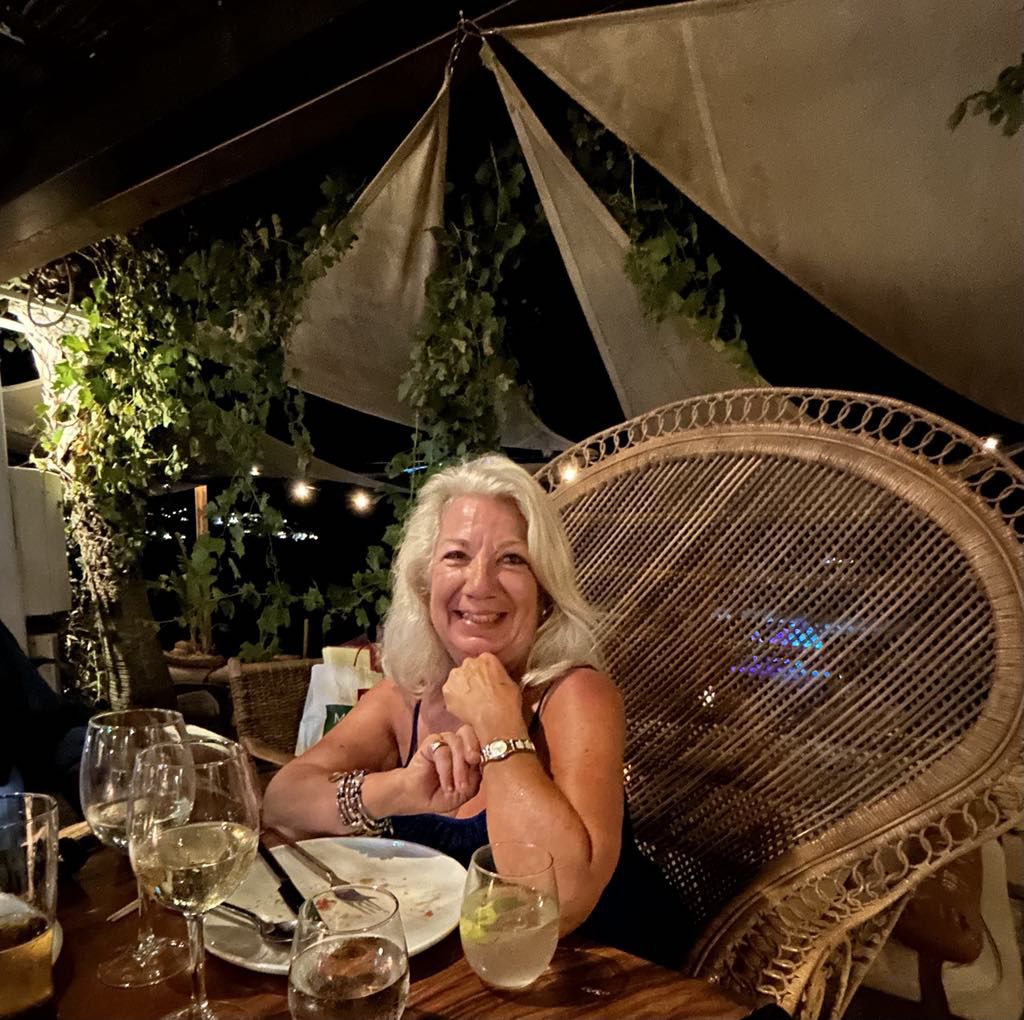
We laughed, we smiled, we danced–boy do we dance–we drank and just really had a good time.

I have been doing this for a decade.
My early September birthday signals the slow down to the season in Mykonos, a drop in temperatures and a gathering of an international crowd that comes to the island–UK, Canada, Sweden, USA–a regular UN party central.

When I sent the invitations at the beginning of August, one friend responded with “You’re doing this again even though it is not a milestone birthday?”
I replied, “Honey, every birthday is a milestone after a certain age. And because we have no guarantee there will be next year, we celebrate while we can.”

I am grateful to be able to celebrate in this manner, with joy, with love, with pretty good health for an old broad with a few too many kilos on her backside!
And our celebration–my birthday– has been kind of reunion event with my friends–so it really is celebration of connection and love, but it also does some good.
I do not want and definitely do not need presents.
So, I ask my pals to make a donation to the Mykonos Cancer Association instead of buying me a gift.

And boy are they generous. This year 1000 Euros was raised to donate to the organization.
And in this way, I can also honor and remember the friends I have lost to the disease who are no longer around to celebrate any birthday.
I pray that all my dear girls rest in peace but smile on us from above, having attended these gatherings themselves; while we mourn them, miss them and feel the deep heartache of not another laugh,
not another hug,
not another glass of wine.
And I am following a path forged by a role model of silver seniorhood!
Age with grace and go quietly into that good night?
No f…..g way!
I am going out with noise and some bang just like a lady I have admired for the last 7 years.
In the early Spring a slender old gal with white hair chopped short and plenty of chutzpah left the earth. My goal is to emulate her—she didn’t get her real artistic start until her 80s!!

Iris Apfel was absolutely outrageous in all the good ways!!!
She was 102 years young!
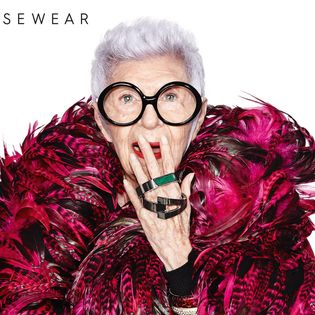
Iris was a New York society matron and interior designer late in who knocked the socks off the fashion world with a brash bohemian style that mixed hippie vintage and haute couture. Iris found treasures in flea markets and revelled in contradictions. She died in her home in Palm Beach at 102!
Iris’s Face Book page is still a good read

She came to fame in the fashion world in her 80s and 90s, and her wildly eclectic closet of clothes formed a hit exhibition at the Metropolitan Museum of Art.

Calling herself a “geriatric starlet,” Iris in her 80s and 90s set trends with clamorous, irreverent ensembles: a boxy, multi-colored Bill Blass jacket with tinted Hopi dancing skirt and hairy goatskin boots; a fluffy evening coat of red and green rooster feathers with suede pants slashed to the knees; a rose angora sweater set and 19th-century Chinese brocade panel skirt.

Her wilfully disjunctive accessories might be a jewelled mask or a necklace of jade beads swinging to the knees, a tin handbag shaped like a terrier, furry scarves wrapped around her neck like a pile of pythons and, nearly always, her signature armloads of bangles and owlish spectacles, big as saucers.
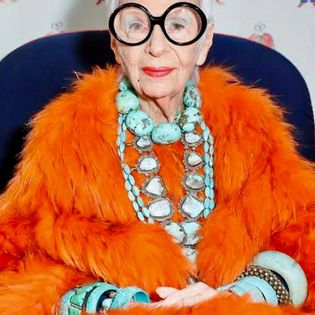
But she had a point.
“When you don’t dress like everybody else, you don’t have to think like everybody else,” Iris said. In 2011 she went on national television, selling scarves, bangles and beads of her own design on the Home Shopping Network.
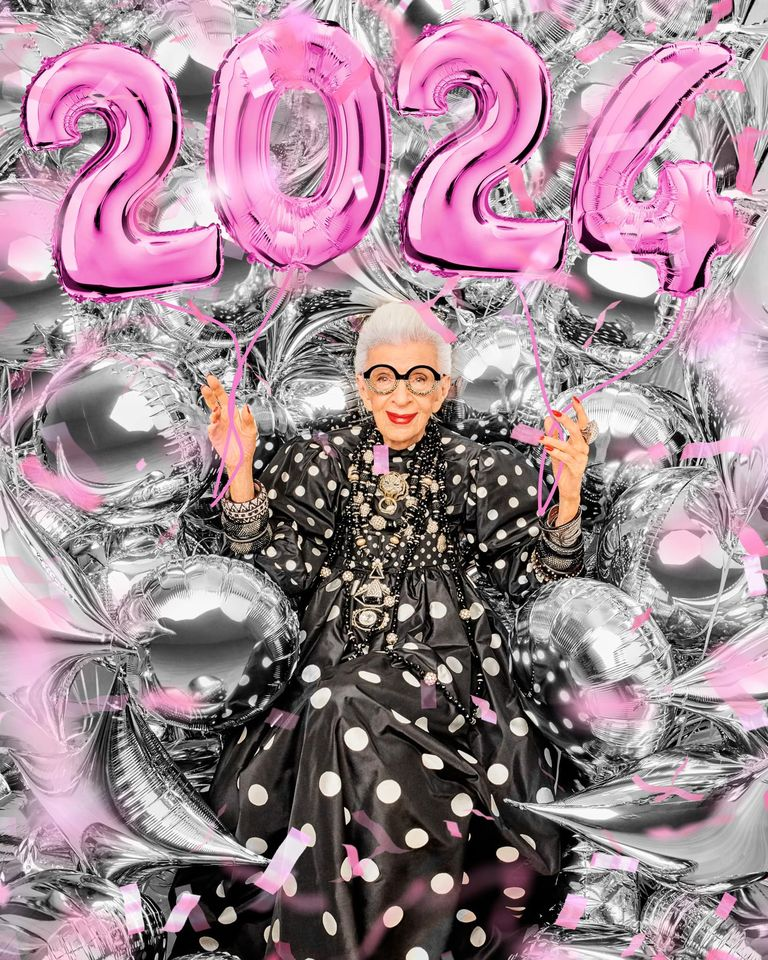
For decades starting in the 1950s, Iris designed interiors for private clients like Greta Garbo and Estée Lauder. With her husband, Carl Apfel, she founded Old World Weavers, which sold and restored textiles, including many at the White House. The Apfels scoured museums and bazaars around the world for textile designs. She also added regularly to her huge wardrobe collections at her Park Avenue apartment in Manhattan.
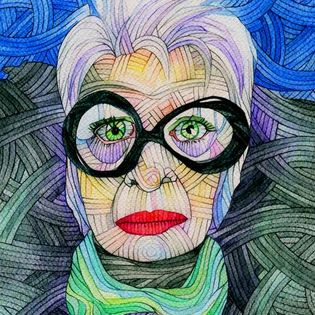
The Apfels sold their company and retired in 1992, but she continued to act as a consultant to the firm and to be the otherworldly woman-about-town, a soaring free spirit known in society and to the fashion cognoscenti for ignoring the dictates of the runway in favor of her own artfully clashing styles.
In 2005, the Metropolitan Museum of Art, facing the cancellation of an exhibition and looking for a last-minute replacement, approached her with an audacious proposition: to mount an exhibition of her clothes. The Met had exhibited pieces from designer collections before, but never an individual’s wardrobe.
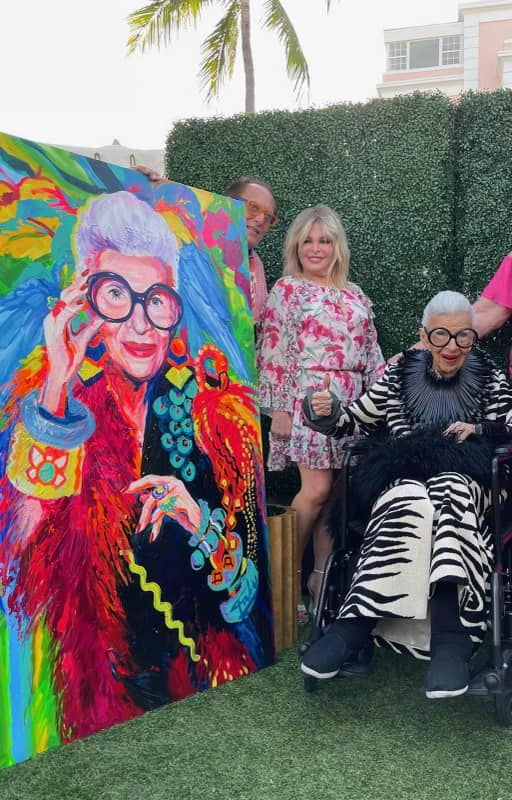
The show, “Rara Avis: Selections From the Iris Apfel Collection,” assembled 82 ensembles and 300 accessories in the museum’s Costume Institute: Bakelite bangles from the 1930s, Tibetan cuff bracelets, a tiger-pattern travel outfit of her own design, a husky coat of Mongolian lamb and squirrel from Fendi displayed on a mannequin crawling from an igloo.
“This is no collection,” Iris said. “It’s a raid on my closet. I always thought to show at the Met you had to be dead.”

Iris was tallish and thin, with a short crop of silver hair and scarlet gashes on lips and fingernails, a little old lady among the models at Fashion Week and an authentic Noo Yawk haggler at a shop in Harlem or a souk in Tunisia. Many called her gaudy, kooky, bizarre, even vulgar in get-ups like a cape of gold-tipped duck feathers and thigh-high fuchsia satin Yves Saint Laurent boots.
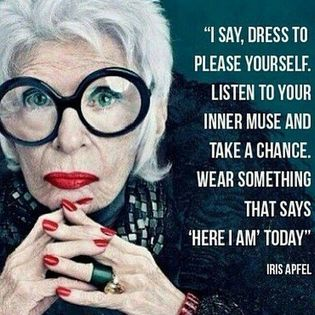
Harold Koda, the curator who helped organize the show, said: “To dress this way, there has to be an educated visual sense. It takes courage. I keep thinking, Don’t attempt this at home.”
Soon the show was the talk of the town. Under an avalanche of publicity, students of art, design and social history crowded into the galleries with the limousine society crowd, busloads of tourists and classes of chattering children. Carla Fendi, Giorgio Armani and Karl Lagerfeld took it in.

“A rare look in a museum at a fashion arbiter, not a designer,” The Times called the show, adding, “Her approach is so inventive and brash that its like has rarely been glimpsed since Diana Vreeland put her exotic stamp on the pages of Vogue.”
That year, at 90, she began selling scarves, bangles and beads of her own design on the Home Shopping Network.

Almost overnight, Iris l became an international celebrity of pop fashion — featured in magazine spreads and ad campaigns, toasted in columns and blogs, sought after for lectures and seminars. The University of Texas made her a visiting professor. The Met show travelled to other museums, and, like a rock star, she attracted thousands to her public appearances.
Mobs showed up for her bookstore signings after the 2007 publication of “Rare Bird of Fashion: The Irreverent Iris Apfel,” a coffee-table book of her wardrobe and jewellery by photographer Eric Boman.

“Iris,” an Albert Maysles documentary, opened at the New York Film Festival in 2014, and in 2015 it was seen by enthusiastic movie audiences in America and Britain. The movie critic Manohla Dargis of The Times called it an “insistent rejection of monocultural conformity” and “a delightful eye-opener about life, love, statement eyeglasses, bracelets the size of tricycle tires and the art of making the grandest of entrances.”
In 2016, lris was seen in a television commercial for the French car DS 3, became the face of the Australian brand Blue Illusion, and began a collaboration with the start-up WiseWear. A year later, Mattel created a one-of-a-kind Barbie doll in her image. It was not for sale.
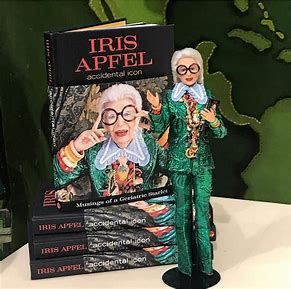
In 2018, she published “Iris Apfel: Accidental Icon,” an autobiographical collection of musings, anecdotes and observations on life and style. As she turned 97 in 2019, she signed a modelling contract with the global agency IMG.

Iris Barrel was born on Aug. 29, 1921, in Astoria, Queens, the only child of Samuel Barrel, who owned a glass and mirror business, and his Russian-born wife, Sadye, who owned a fashion boutique. Iris studied art history at New York University and art at the University of Wisconsin, worked for Women’s Wear Daily, apprenticed with the interior designer Elinor Johnson, and opened her own design firm.

She married Carl Apfel, an advertising executive, in 1948. They had no children. Her husband died in 2015 at the age of 100.
Their Old World Weavers had restored curtains, furniture, draperies and other fabrics at the White House for nine presidents, from Harry Truman to Bill Clinton.
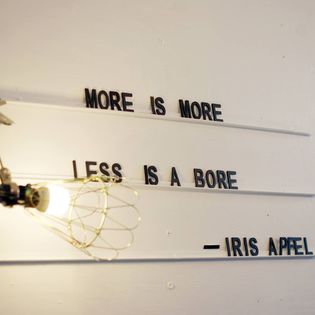
Iris became a style and fashion icon in her 90s.
I am not seeking fashion fame, but I do hope my 80s and 90s will be memorable, not only for me but those around me–in good, outrageous ways.
I hope you will embrace aging with the attitude that “the best is yet to come!”
Be Iris- an influencer before influencer had a name!!!


 Stacey Seaside
Leave a reply to Anonymous Cancel reply