

Spring heralds a long-standing tradition.
High schools and college campuses
fill with parents, family and friends.
Graduations are just around the corner.
Cap and gown ceremonies are everywhere.
Celebrity guest speakers as well as class valedictorians offer inspiration.

But what will inspire the class of 2024?
This is the same class of kids whose high school experience was cut short by the cancellation of proms and graduations in 2020.
The class of 2024 has suffered through one of the most disruptive and unconventional college experiences in modern history.
Their young lives began with the chaos of COVID.
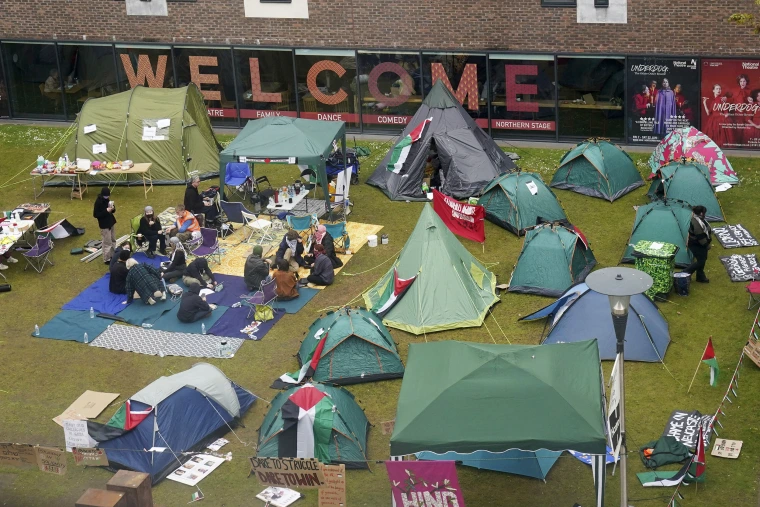
Student life is ending with pro-Palestinian protests bringing news cameras, lawmakers and riot police onto campuses — and threatening graduations and other aspects of normal student life.
Students kicked off freshman year remotely.
And when they eventually arrived in person, they lined up for weekly COVID tests — and missed out on parties and all that other important social indoctrination known to campus life while keeping 2 meters apart!
Just as that class gets a second shot at celebrating the graduation milestone, an emotionally charged protest movement with global political implications has spread across the planet.
Many campuses have encampments on the same lawns where they typically set up graduation tents and stages.
Graduating this year is unique.
The largest campus protest movement of the 21st century are taking place.
The first criminal trial of a former U.S. president monopolizes the new cycles.
The most restrictive abortion laws in the USA are making women across the globe stand up to protect their bodies and their personal choice for what they do with them.
Two horrific wars in the north of Europe and on the edge of the Mediterranean continue that have no end in sight.
These students have made course adjustments on the heels of the first pandemic in living memory,
one that claimed the lives of millions.

The world seems bitterly split with vocal advocates for both authoritarianism and democracy.
And anyone on the opposing side is demonized.
Perhaps bigger than remembering a commencement ceremony laced with too much alcohol from the night before, this graduating class will remember how their activism changed the status quo.
They are using their voices–mostly in peaceful demonstration–to make the entire world sit up and listen.

Graduating student are exhausted and anxious.
They are repulsed by the slaughter in Gaza,
They’re cynical about politics.
They don’t want to have children and bring them into a world imperilled by
conflict and
climate change and
authoritarianism.
They don’t want to relive 2020 in a remote job.
Uttering “Zoom” anything is blasphemy.

In the USA, graduates have lived through mass shootings and culture wars.
They recall a Trump administration spewing hate and bigotry and giving tax cuts to the wealthy, and fear another President Trump who’s even less constrained.
How can they use their lives and careers to make their nations better?
How can they try to heal the world?

So what hope can we give the class of 2024?
What should they look forward to?
What ambitions do they have for themselves?
What kind of world do they want to live in?
And how can we help them?
The actions they have taken on campuses across the globe should empower them.
The world is listening to them.
Political leaders and provosts are taking action based on their demands.
And that perhaps is the biggest takeaway from their protests.
Peaceful demonstration for a just cause begets change.
Political activism benefits the community
In my own youth, my biggest claim to political activism was attending a campaign speech by John Anderson who spoke to NIU students in DeKalb. The speech was broadcast on national television.
He was running for president in 1980 challenging incumbent Jimmy Carter and Republican nominee Ronald Regan.
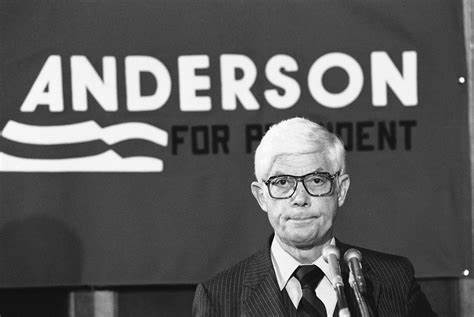
Anderson’s campaign was notable for several reasons. He ran as an independent candidate, originally a Republican congressman from Illinois, who entered the race as a moderate alternative to the major party candidates. He advocated for a centrist platform, focusing on fiscal responsibility, environmental conservation, and social liberalism. His campaign gained traction, particularly among voters disenchanted with the perceived extremism of the two major parties.
One of the defining moments of Anderson’s campaign was his participation in a presidential debate with Carter and Reagan. Despite initially being excluded from the debate by the Commission on Presidential Debates, Anderson’s popularity prompted the commission to change its rules to allow his participation. This was the first time an independent candidate had been included in a presidential debate since 1948.
Ultimately, despite his strong showing in polls and debates, Anderson finished third in the election, with Reagan winning in a landslide. However, Anderson’s campaign left a lasting impact on American politics by demonstrating the potential influence of independent candidates and the demand for more moderate political alternatives.
My own attraction to Anderson was that he was from Illinois and he was willing to challenge the norms.
And maybe the fact that I appeared on nationwide television, in a five second interview about why I wanted to vote for him.
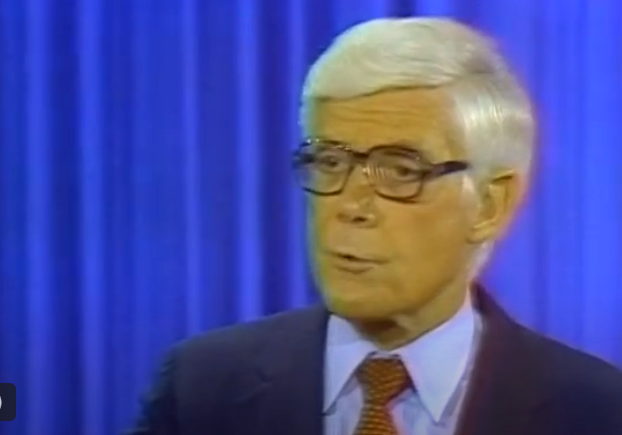
At the time, I felt I was on the wrong side of the camera.
As a journalism major I wanted to be holding the microphone. Mostly I was the one asking the questions and frantically scribbling notes for the article.
Instead, I found myself on camera telling the nation why I was voting for Anderson.
What did I say? Something about the fact that he actually seemed to be listening to me and my peers–he had outlined programs for earth advocacy–being kinder to the planet– and manifesting social justice through government.
My own tilt from journalist to political activist
Fast forward to from September 1980 to September 2020. I have gone from writing about others and issues to being interviewed and quoted in Greek national media.
From November 2019 to December 2022 I served as the country chair for Democrats Abroad Greece. I represented almost 1500 members of a US political party based in Greece and was part of a larger global organization with 200,000 members.
About 15 years earlier, I was actually recruited to develop content and write articles for the local organization. I served as communications chair and media guru for a time. In my first elected position I became vice chair.
It turns out that I wasn’t just informing–I also was committed to what I was promoting. I believed in it so much that it became easy to talk about and discuss and to explain to others. I was actually comfortable in interviews and on camera–in both Greek and English.
My journey of personal and professional growth had taken four decades.
In the autumn of 2020 I knew that if I wanted the world to be a better place, I had to get Biden elected.
I hope that this year’s class of graduates will not take 40 years to find their niche in the world!
I hope they will identify the path of their journey sooner than I did!
It seems students across campuses worldwide are more invested in political activism today because their protests are beginning to bear fruit.
4 prods from Stacey for the Class of 2024
If I was tasked with addressing graduates today I would tell them 4 things to send them off campus and into the world.

Look up from your phone, your screen, your device.
There is a world out there to be seen, heard, smelled and touched. Don’t disconnect from the actual world because you are too engrossed in the world on your screen.
2. Embrace adaptability.
You have already navigated a pandemic and come out on the other side of it. If you got through Covid 19 without getting arrested or hospitalized you have learned flexible survival.
3. Create your own unique path.
There is no–you must or you should. If not now when will you be free to forge a path that incorporates your dreams and your fantasies of the life you imagine for yourself?
Advice from friends and family is good and well-intended. But what do you really want for you?
4. Use your true voice.
Speak your truth, tell your story, be brutally honest when it comes to what you want to do and how you plan to get there. Whether you are engaging your political activism or advocating for improved working conditions, be vocal.
Be passionate –and peaceful– in driving positive change within your community. Ruth Bader Ginsberg said, “Fight for things you care about, but do it in a way that will lead others to join you.”

Ultimately, the most powerful source of inspiration for the graduating class of 2024 may come from within themselves and their peers.
Their own actions demonstrate their values, passions, and aspirations.
This year’s graduating class will make a positive impact on the world through political activism.
What would you like to say to the graduates?
What inspiration can you offer them?
Apologies if today’s post as well as last week’s post on student demonstrations travel outside the realms of Stacey’s Seaside Greek island experience.
The topics are both heavy and politically charged.
I feel passionate and compassionate for this generation heading out into a very challenging world.
40 something years ago, when I graduated from college, it was a cake walk by comparison.
The job market was flooded with opportunities. And the economy allowed for everyone who wanted financial independence to have it. Salaries and the cost of living allowed us to buy a car–albeit on payments, rent an apartment for ourselves and even put a little money away.
Today’s graduate is not as lucky.
Next week’s post will focus on my own good fortune and joyful living in choosing seaside residence.

 Stacey Seaside
Leave a comment