
For more than 10 years I have been a winter swimmer
Willingly letting the waves wallop me in winter, I gladly plunge into the sea at every opportunity.
But Nyad I am not.
Diana Nyad, perhaps a familiar name because of a recent Netflix release, is a legendary swimmer. Nyad-whose Greek father repetitively reminded her that her name literally meant water nymph- tells the story of the distance swimmer’s challenge to herself, to swim from Cuba to Florida. A 60th birthday triggered the memory of failed attempts of her youth. More focused and more determined, with six decades of experience and determination, she revisits the challenge.
I repeat, I am No Nyad. But oh my God, I do love to swim.
And I do it with determination and devotion.
I have no interest in distance swimming or breaking a record or breaking a sweat!
In fact, one of the reasons I love swimming as an exercise is no sweating!
As I wake each day I listen for the wind and look out the window searching for the sun with my first thoughts being–can I swim today?
On the days when the weather is miserable my step is heavier and my mood blackens. I have to scrap my normal beach routine for a detour indoors. I will miss the sand on my feet, the liquid luxury lapping my skin and the sunshine warming the mood as it sparkles across the water. There is little that can replace the natural euphoria this generates in me.
A memory showed up on Facebook a few days back.
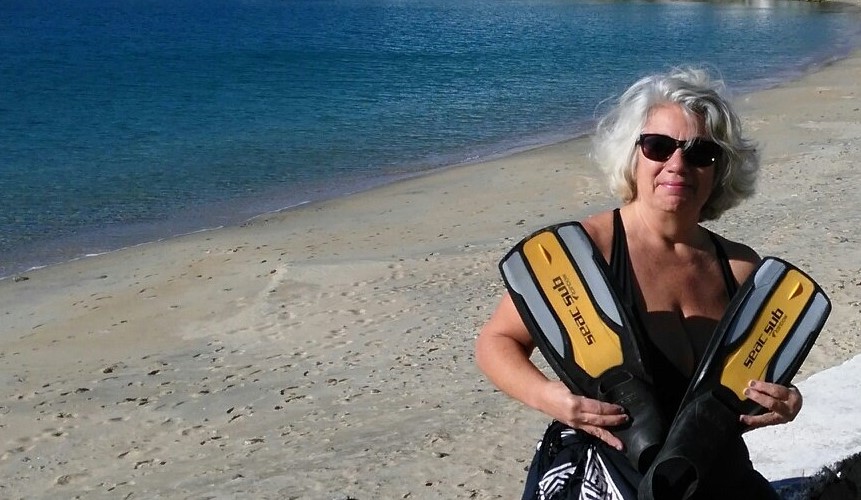
I was just emerging from the water, holding my fins in late December of 2015 at a favorite beach, Agios Stefanos.
That prompted my count of how long I have been taking the daily plunge winter or summer.
Big chill brings on chunky dunking
My blue temptress lured me seaside following a tempest. The winter of 2011 was the first back in Mykonos following two years in Athens. (My sons were enrolled in a private school in the Acropolis Metropolis.)
Grey, brooding skies, filled with vengeance seeking clouds and gales halting ferry traffic for several days, finally gave way to the “Alkyonides.” They are more widely known as the halcyon days of winter. The temperatures soar, the sun shines, the skies are azure and the waters calm for a few days or a few weeks.
The stormy days that cast their doom and gloom moved aside to allow for such halcyon days that February of 2011. Stepping out on to the veranda it felt like the onset of spring. By the third such day in a row, I crossed the island and planted my self on Agios Yiannis Beach.
Agios Yiannis beach is another favorite beach for many reasons but mostly because it is south facing, protected from the harsh north winds and has a view across the channel of Delos-the largest archaeological site in Europe, with 3,000 years of cultural heritage. I set out my towel and plopped down in the sand.
As the sun shone bright, I was slowly warming, discarding clothing, one piece at a time until finally I was down to the swimsuit. When I could stand the heat of the sun no longer, I rose and walked to the waters edge. I got as far as my ankles and the icy water burned at my skin.
I could turn around, dry my toes, get dressed and head home or I could just keep walking, ignoring the frigid liquid.
I kept going. The incline is steep and with a few steps I was shoulder deep. I began to swim as fast as I could, using the top of Mount Kynthos on Delos as my focal point. I swam out about 500 meters and then turned around and swam back to shore. The entire dip was no more than seven minutes but I felt victorious.
Back on the beach, I shed my swimsuit and dressed in my dry clothing. My hair was wet. I squeezed as much moisture out with my hands so the cold drips would not go down my back. I sat back on the towel and let the sun bathe me with its warmth.
I left the beach and went home. I was satisfied and happy. I felt great.
Determination and desire forced me to face
A. icy water
B. the isolated beach
C. endurance
D. trying something new
I would like to say I took many more such afternoon plunges in 2011 but I was still working full time in my exe’s retail business, I had a son who needed to be chauffeured to and from lessons so my time was limited.
I did make a point of swimming daily throughout the summer that year. When autumn arrived I was determined to keep going for as long as I possible.
In 2012, I made it all the way to February. I stopped only because I travelled to the States.
How cold is it?
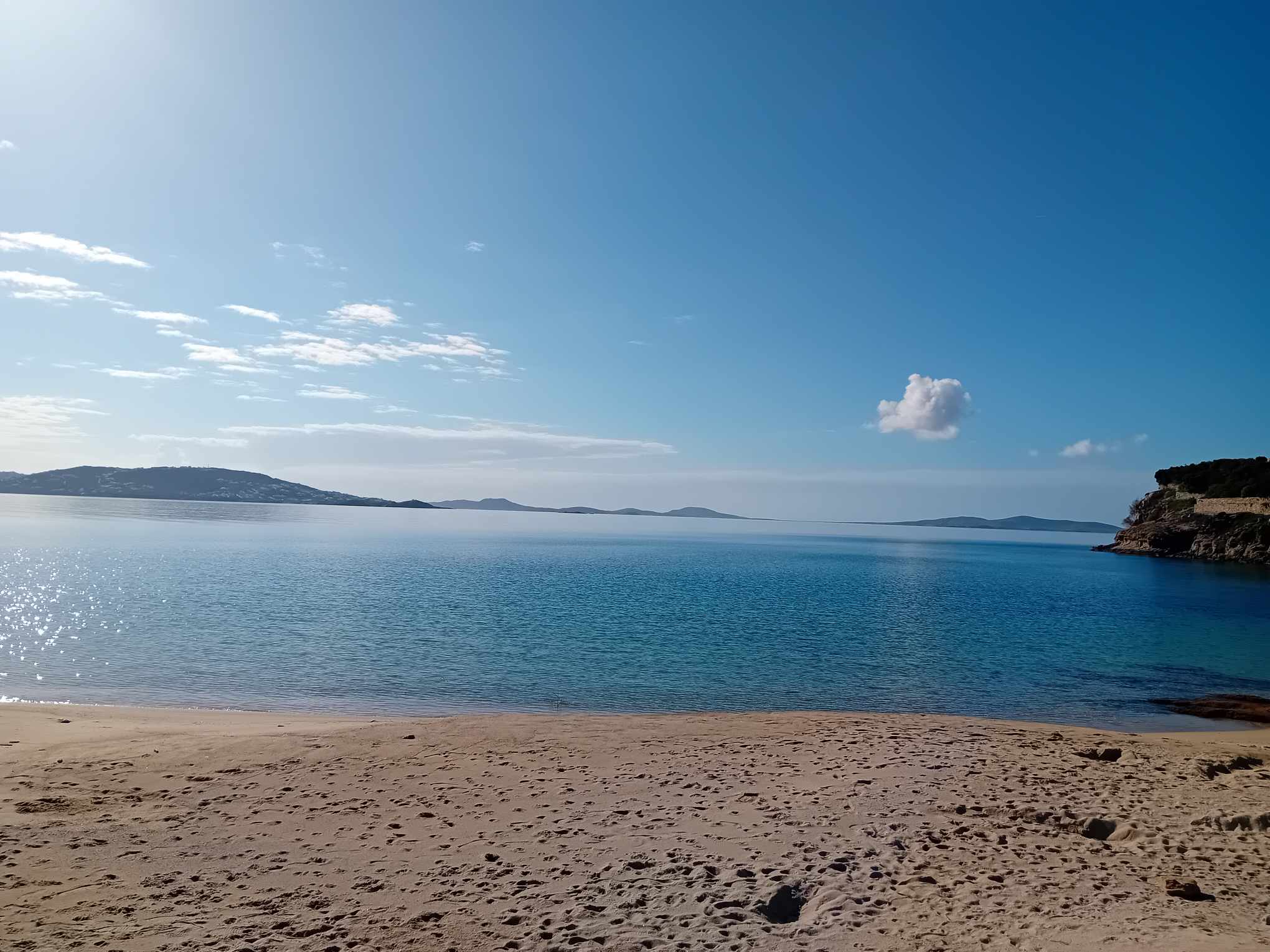
Since the initial winter swim, I continue to take that daily plunge whenever possible. And where I take that plunge literally depends upon which way the the wind blows. South winds will send me to Korfos beach, northerlies send me to Agios Stefanos, pictured above.
My swim will keep me in the water a minimum of 30 minutes and sometimes as long as 70 minutes. I do specific strokes across the bay of the beach and work on arm, leg and core building. And as soon as I am out of the water, it is off with the wet and on with the dry. Although I never really feel cold as I swim, frigid air and wind will penetrate you to the bone if you try to “drip dry” on a winter day!
There are plenty of studies and research to back up the “good for me” in what I do daily! Even if it means an initial big chill.
Apparently cold water immersion primes you for mental and physical challenges.
Cold-water swimming is defined as that which involves temperatures below 15 degrees Celsius or 59 degrees Fahrenheit. The Aegean Sea ranges from 18 to 24 C in the summer months and 17 to 10 C in the winter.
Swimming in water with temperatures below 5 degrees is considered ‘ice swimming’. At this temperature you get brain freeze–like when you eat ice cream too quickly. I don’t do ice swimming because in the Aegean Sea we never have temperatures that low, fortunately.
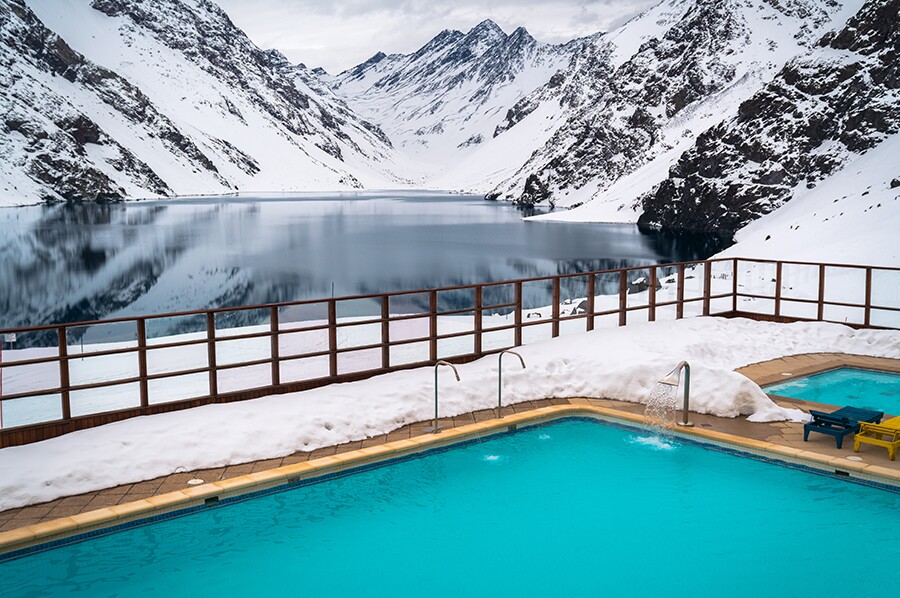
And no, the photo below is not an example of ice swimming. There may be snow and ice but a heated pool in the mountains doesn’t cut it! However, a dip in the lake beside it does count!!
Researched backed benefits of the big chill
Professor Mike Tipton, an environmental physiologist at the University of Portsmouth studies how people react to sudden immersion. Tipton is a winter swimmer himself.
Mood benefits of cold water swimming can be divided into two phases: the initial ‘cold shock’ response, and then adaptation that happens over the longer term, according to Tipton.
Cold water shock–think beyond the ice bucket challenge and instead a full body plunge! Deep gasp, heart begins to pound, there is a sense of panic and a burning sensation on your skin. Within your body, your blood pressure escalates, adrenaline pumps while glucose and fats are released. Your body is in flight or fight response, preparing to either attack or make escape from the hostile environment.
Adrenal glands release the stress hormone cortisol. Beta-endorphin hormones surge in the brain. This provides pain relief and a sense of euphoria.
After six immersions, your body reduces the cold water shock response in half, according to Tipton. So your body learns to adapt: your heart rate, breathing and sense of panic are 50 percent less than the first immersion. Adapting makes you less reactive to the shock of cold water. Tipton said that could also make you less reactive to everyday stress.
Dr. Mark Harper, an anaesthetist at Brighton and Sussex University Hospitals, is especially fascinated in one specific component of the stress response. He studies the positive effects of cold water swimming. He also performs experiments in cold water immersion. According to Harper, just as stress of cold water emersion causes an adrenaline surge, triggering flight or fight, it jumpstarts the body’s immune system, preparing for wounding or infection. So cold water swimming makes your body more ready to fight germs that can make you sick.
Epiphany inspires an epiphany?
Two days from now, young men and women throughout Greece will brave a faithful dive into rivers, lakes and the sea. Their mission is to retrieve the cross used to bless those waters on Epiphany. Clad in just swimsuits at the water’s edge, they wait for the priest to complete the prayers and toss the cross. As the cross goes airborne there is a flurry of bodies colliding with the water until one devout arm rises up holding the cross. Some are regular swimmers but those that are not will experience the shock of that cold water submersion as an act of faith.
Perhaps being a witness to this Greek Orthodox ritual for the better part of four decades inspired my winter dips. I always admired the youngsters for their faith and their willingness to plunge.
Winter swimming apparently helps me deal with stress triggers more effectively. My body fights off infection more efficiently than most. Only once since 2012 have I had the flu, a cold and Covid. Winter swimming seems to be a natural, free therapy, keeping me truly “well.”
Low impact on the joints and the NO sweat activity adds to these benefits.
If you have a natural body of water close by, I encourage you to embrace it with use. Start in summer and keep going.
Even on the worst days, I remind myself that Mykonos is a mecca for those who want to enjoy her beaches.
I am blessed to have these beautiful beaches without the expense of a long flight and a hotel stay. They are particularly enjoyable off season, when the crowds and paraphernalia of umbrellas and loungers have disappeared. But my winter immersions have not been limited to Mykonos. When I find myself in other areas of Greece I have taken the winter plunge — often finding a community of other winter swimmers!
Take the plunge-winter swimming will give your immune system a boost, keep you less stressed and give you the liquid embrace that will continue to buoy you throughout the day!


 Stacey Seaside
Leave a reply to dimoualeka Cancel reply