

To some it looks like a simple device to navigate the television.
To me, it is a weapon of mass destruction.
There is nothing more terrifying than a television remote control.
Particularly if it belongs to somebody else.
The damn things confound me.
Yes I, who am not queasy about much, panic when I see the devil’s device of dominion.
I even did quite a stint in service as the family’s actual “television remote control.”
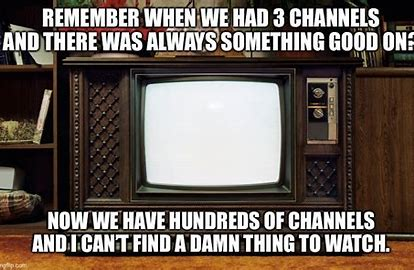
Those of us that were children of the 50s, 60s and 70s got up from the chair, stood in front of the boxed in screen, turning the dials to the 5 or 6 television stations that existed.
I had the benefit of living in suburban Chicago. Along with the national networks of ABC, CBS, NBC and PBS the windy city folks benefited from the local programming of Channel 9-WGN as well as WTTW. They carried lots of foreign language programming–Spanish, Polish, German and even a Greek hour on Sundays.
I digress.
While “in service” I would hear it from my brother or dad, telling me to move off to the side, so they could watch the screen, to see what programming was on offer.
I turned the dial dutifully.
When we agreed on what to watch, I would adjust the volume, and go back to my seat. At the end of the program, once again, I would pop up to adjust our course in the evening’s entertainment.
On to Off
Today, just trying to turn the tv set on, even without the remote becomes mission impossible.
Now that we all have flat screen TVs, all you see is the screen.
No buttons, no dials, no levers. Turns out you have to feel up the sides or top of the screen to find some buttons.
If you are lucky, you find the power button.
If you are super lucky there are also barely there buttons to change channels and adjust volume.
Mission Impossible
Fast forward to a few days back while I am happily sipping wine with a friend. She comments that another US shooting has been all over the Greek news and we should probably watch the breaking story. She sends me into the living room and tells me to turn on the TV while she brings snacks from the kitchen.
I spot not one but two television remotes on the coffee table.
One is silver; one is black.
And there is only one massive flat screen staring me down in blackened darkness.
I look at both and am paralyzed by fear.
These remotes have a kazillion buttons on them, in a rainbow of colors with odd combinations of capital Latin letters. Some have symbols on them of arrows pointing in a variety of directions, even backwards.
I have landed on the Enterprise in an episode of Star Trek. I have to get the ship out of a shower of enemy attack. But I am no Captain Kirk and there is no Uhura or Spock to prompt me! Where is the “Sheilds Up” button or the “Warp Drive Button?!?!?”
Both remotes have that little red button on the top corner that usually signals in most of the civilized world: on/off. I might be able to save the Enterprise after all.
I take a chance and bet on the black since it also says Samsung.
I press the button.
Nothing happens.
The blackened screen continues to silently stare me down.
I take a big gulp of wine.
I pick up the silver remote and hit the red button.
I hear a click and the room fills with a decibel level that could puncture an eardrum as the screen flashes with boxes of talking heads, all screaming at once in Greek.
I scramble to find the plus/minus buttons for volume control.
There are two columns.
One will hopefully adjust the volume.
The other will change the channel.
I roll the dice and choose the column on the left because the lettering is so small I cannot read which will do which.
The screen flashes.
I have moved to another channel.
A Turkish melodrama with Greek subtitles and just as loud as the talking heads.
I hit the red button.
Back to black and silence.
I collapse on the couch and then reach for the wine glass to down the rest.
Debbie walks into the living room with snacks.
“I thought you turned the TV on?”
“I did and then I didn’t. I need more wine. Do you think Star Trek is playing on any of these channels?”
Learn and learn again, and again …
We of a certain age had to learn to navigate our mobile phones.
I feel quite adept when it comes to MY smart phone.
But oh God, please don’t hand me yours and ask me to figure out what is wrong.
All these buttons are so nuanced you need a degree in engineering to answer a call.
And so it goes with the damn TV remote.
Now, we live in fear of the television remote as it could shut off our refrigerator, bill us for a service we don’t want or send us into some TV twilight zone.
So who should I blame for all my angst?
The historical perspective on remote controls
Although remotes are most closely linked to television control in popular culture, these devices are an invention born in the 1800s.
Nikola Tesla created one of the world’s first wireless remote controls, which he unveiled at Madison Square Garden in New York City in 1898. He called his fledgling system, which could be used to control a range of mechanical contraptions, a “teleautomaton.” For his demonstration, Tesla employed a miniature boat controlled by radio waves. The boat had a small metal antenna that could receive exactly one radio frequency.
Tesla sent signals to the boat using a box — his version of a remote control — equipped with a lever and a telegraph key (originally designed to send Morse code signals). The signals generated from this box shifted electrical contacts aboard the boat, which, in turn, adjusted settings for the rudder and propeller, allowing the operator to control the boat’s motion.
Financially, Tesla’s remote-controlled boats were a flop. His intended client, the U.S. Navy, thought the technology was too flimsy for war. But the concept of remote control caught on and quickly spread to many other types of equipment.
Shortly after Tesla’s breakthroughs, Spanish engineer Leonardo Torres-Quevedo used wireless telegraph transmitters to control first a tricycle, then an engine-powered boat, and even submarine torpedoes.
In the 1930s and 1940s, a few consumer electronics, such as garage door openers and model airplanes, arrived with remote controls. Other products soon followed suit, but this was still just the beginning for remotes, which have radically altered our technological landscape.
In World War I, the German navy used remotely controlled boats loaded with explosives to attack opposition ships. It was the advent of a new type of warfare, in which armed forces could direct armaments from a distance. During World War II, the German and American armed militaries also experimented and deployed a range of guided missiles and torpedoes.
Aversion to disruptive commercials sparked the television remote
Zenith Electronics president Eugene McDonald gave the company’s engineers a challenge in the early 1950s. He hated having to sit through commercials as he watched television. He wanted a device that could let him mute commercials or skip to another channel that had programming and not another commercial on.
The remote control as we know it was born.

McDonald’s desire launched a revolution in television viewing. Viewers, sitting from the comfort of their seat, could change what they saw. Without barely a muscle moving.
The Flashmatic, released in 1955, the Zenith gamechanger, was designed by Eugene Polley, a mechanical engineer.
There had been devices that could change TV channels before, but these had been attached to the television itself with a snaking cord. The most famous of these was Zenith’s own Lazy-Bones. It allowed the user to turn the TV on or off and change channels – but not mute those pesky commercials.

The Flashmatic looked like a toy ray gun and worked by tripping a sensor in the corner of the screen.
The Flashmatic was completely free of the TV set. It used a directional light source with a sensor in each corner of the TV screen. This allowed the viewer to mute the sound, turn the channel over to the left or the right, all by flashing the button at the screen.
There was one big problem. The four sensors in the corner were sensitive to more than just the light being zapped from the TV watcher’s hand. Depending on where your TV was located in your living room, even sunshine could actually turn on the TV or change the channels.
The Flashmatic added $100 on to the price of a television set. At that time you could buy a car for $600.
Space Command became the next generation
Zenith went back to the drawing board – this time the drawing board of one of its electrical engineers, a physicist named Robert Adler.
Adler’s invention got rid of the zapping light rays of the Flashmatic. He would have to come up with a new way for the remote to message the TV.
One idea was radio waves, but that was dismissed early on because you might start changing the channel on the neighbour’s TV as well as your own.
Adler used sound. The new Zenith remote, called the Space Command, was an ultrasonic remote that used hammers hitting aluminium rods within the remote. These rang at certain frequencies – forcing the television to turn on or off, changing the channel or muting or un-muting the sound.
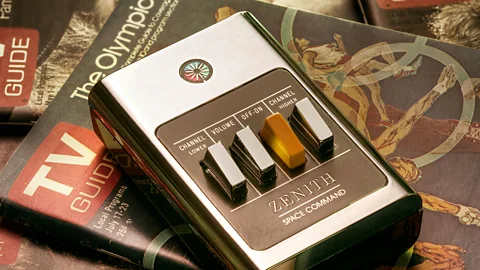
The frequencies used in remotes like the Space Command were too high for the human ear to pick up, though they could be discernible to animals such as dogs and cats.
TV remotes had no more than a handful of buttons until the mid-1970s.
Enter the next phase of the TV remote. The increasing need for more and more functions led the designers to look for a different way of communicating with the TV set.
The BBC partly created the need for a more complicated device. In 1974, it launched Ceefax – a text-based service which used spare capacity in the analogue TV frequencies – in the UK. It was, however, impossible for most TV viewers to call up the pages of news, sports and financial information using a normal remote.

Cable TV and add on devices create more complicated devices
The arrival of cable television in the 1980s, with dozens and dozens or even hundreds of channels, ushered in an era where programmable remotes had to operate many different functions and a diversity of televisions. The remotes, like the cable systems themselves, became more difficult to deal with.
A new controller had to be created, one that would have space for a number keypad (to call up the different page numbers) and to switch between the text service and normal TV. The remote as we know it was beginning to take shape
Through the 1980s and 90s, with the rise of cable TV and the explosion of ancillary devices such as video recorders, DVD players and games consoles, the remote became… rather bloated.
Television remotes have become more complicated over time thanks to our laziness as humans, televisions that are now rich with programming features such as recording, adding subtitles as well as accessing online streaming services.
Overall, the increasing complexity of television remotes reflects the expanding capabilities and features of modern TVs, as well as the demand for greater control and convenience from users.
Remotes have created an entire lifestyle of motionlessness — unless you’re fighting to grab the controller from someone else
Smartphones are becoming universal remotes that can control a multitude of digital products. With the right app, you can use your phone to unlock a car door from miles away, schedule your DVR to record a TV program, control YouTube on your laptop, or, you guessed it, change channels (and a lot more) on your TV.
So are remotes making it easier for us humans?
Remote controls have allowed humans to perform many tasks that would be difficult, if not impossible.
Remote technologies have more serious purposes, too. There are now all sorts of precision-guided munitions used in conflicts all over the world.
Remotes have a long history but it is doubtful we have come to the end. As we continue to weave technology into every aspect of our lives, it’s very likely that we’ll need remotes to keep things “under control.”
Now that “Alexa” has entered our contemporary homes as a voice controlled AI remote device, is her existence going to simplify or complicate our “control” even further?
My own paranoia asks “Do we control the remote or is the remote controlling us?
I would love to hear your take on how remote devices–particularly the devil’s device of dominion–aka the TV remote– have affected you?


 Stacey Seaside
Leave a comment